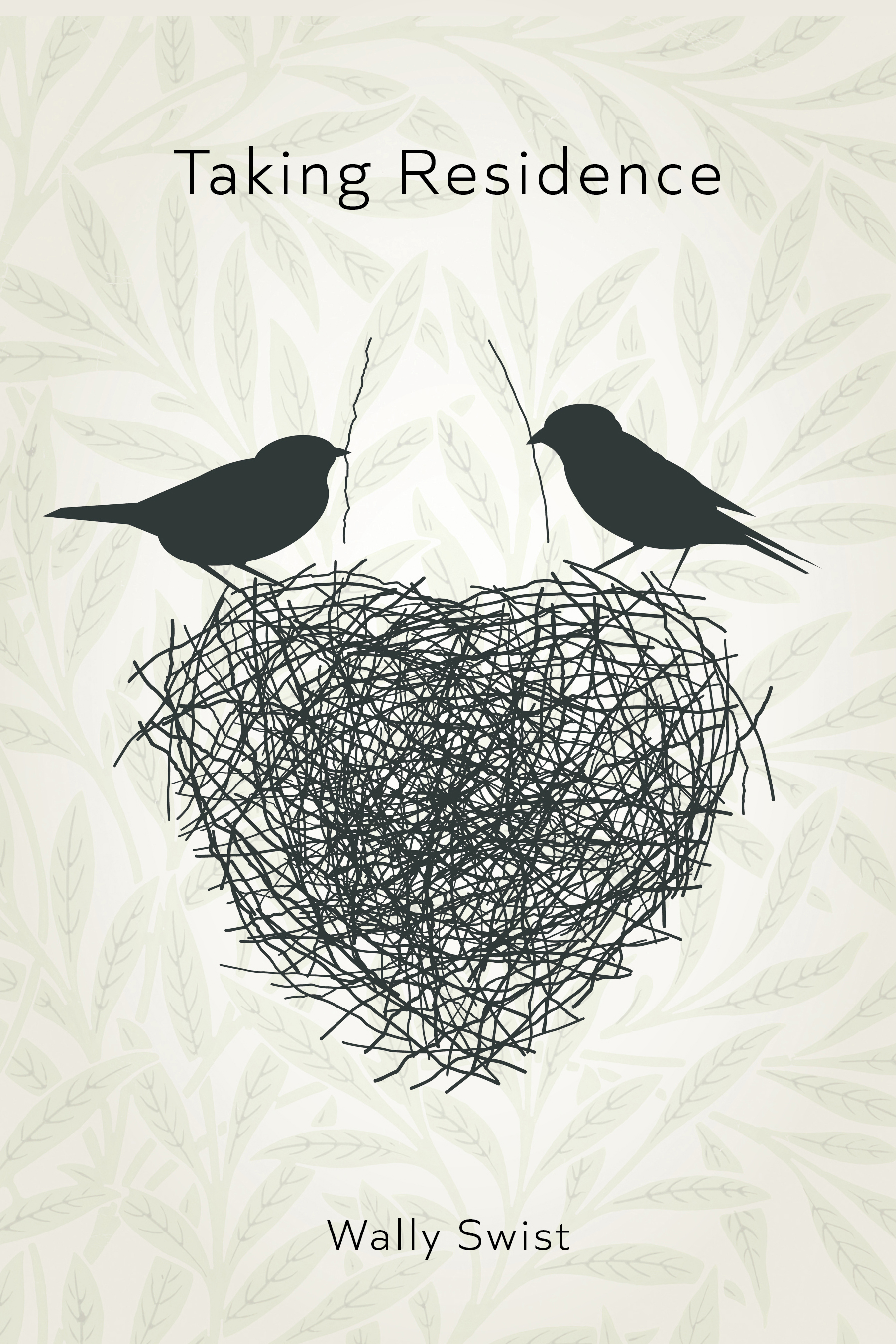
Taking Residence poems by Wally Swist
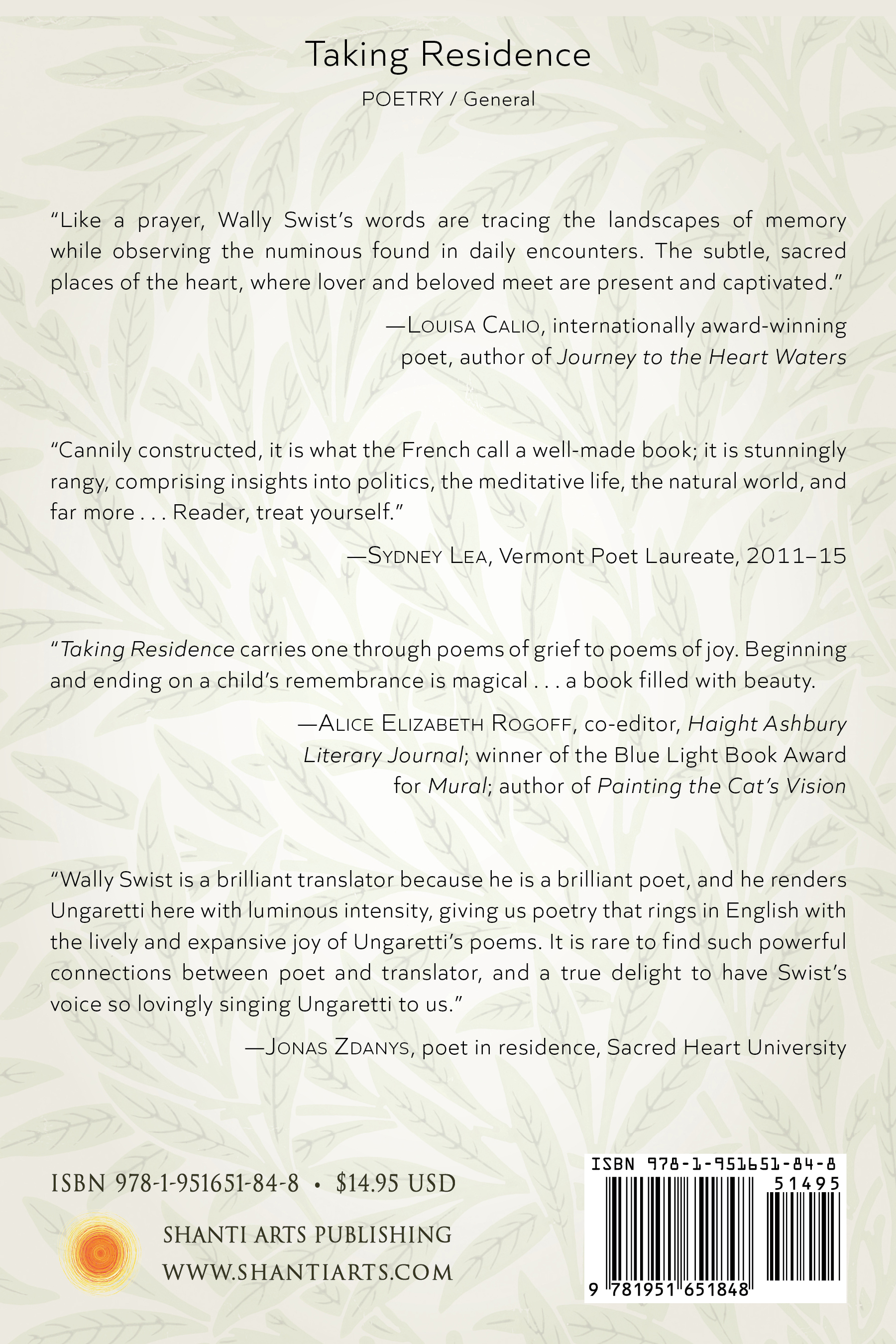
Rainer Maria Rilke wrote in a letter—later collected in the posthumous book Letters to a Young Poet—that a writer always has a storehouse of inspiration to draw upon from childhood memories. Wally Swist’s seventeenth full-length collection of poetry, Taking Residence, begins with poems regarding childhood memories and, in quite a symphonic manner, concludes with them. A collection containing poems honoring the natural world, a suite written as a tribute to a friend who passed, twenty-six poems that are translations from the Spanish of Federico Garcia Lorca and St. John of the Cross and from the Italian of Giuseppe Ungaretti; the poet drawing from mindfulness practice and the practice of presence, the political cacophony of the last presidential administration, and spiritual and substantive nourishment Gastronomique—these are poems that address what it is to take residence in the heart, which Carl Jung spoke to when he offered that after a long life of studying the psyche and the soul, he just might have started to live his life at the level of the heart chakra. Taking Residence is a multifaceted and layered book of poetry built upon the foundational notion that “learning what it is that is taking residence in the heart” is a worthwhile and lifelong pursuit. POETRY / General ISBN: 978-1-951651-84-8 (print; softcover; perfect bound) Released June 2021 158 pages |
|||||||||||||
 |
|||||||||||||
|
Among his books are The Daodejing: A New Interpretation, with co-authors, David Breeden and Steven Schroeder (Beaumont, TX: Lamar University Press, 2015). His book Huang Po and the Dimensions of Love was selected as the co-winner of the 2011 Crab Orchard Series Open Poetry Contest, judged by Pulitzer Prize-winning poet Yusef Komunyakaa; the book was published by Southern Illinois University Press in 2012, and was nominated for a National Book Award. Swist is the winner of the 2018 Ex Ophidia Press Poetry Prize for A Bird Who Seems to Know Me: Poems and Haiku Regarding Birds & Nature. The book was published in late 2019 by master printer and book designer Gabriel Rummonds, of Bainbridge Island, Washington. He has also published five previous books of poetry with Shanti Arts, of Brusnwick, Maine, including Candling the Eggs (2016), The Map of Eternity (2018), The Bees of the Invisible (2019), Evanescence: Selected Poems (2020), and Awakening & Visitation (2020) . His books of nonfiction include Singing for Nothing: Selected Nonfiction as Literary Memoir (Brooklyn, NY: The Operating System, 2018), On Beauty: Essays, Reviews, Fiction, and Plays (New York & Lisbon: Adelaide Books, 2018), and A Writer’s Statements on Beauty: New and Selected Essays and Reviews (Brunswick, Maine: Shanti Arts, 2021). Some of Swist’s work has been set to music. This includes his poem “The Rush of the Brook Stills the Mind,” which inspired a composition by the electroacoustic composer Dr. Elainie Lillios. The composition was performed by percussionist Scott Deal in Jordan Hall at the New England Conservatory of Music in Boston, Massachusetts, on June 20, 2013. It is only one of several venues across the country where the composition has been performed. Dr. Elainie Lillios is Professor of Composition at Bowling Green State University. His poem “After Long Drought” was also composed to an electroacoustical score written by Professor Lillios, and the composition was also premiere at Jordan Hall at the New England Conservatory of Music, in June 2016 by percussionist Scott Deal. A recipient of Artist’s Fellowships in poetry from the Connecticut Commission on the Arts (1977 and 2003), Swist was also awarded a one-year writing residency (1998) and two back-to-back one-year writing residencies (2003–2005) at Fort Juniper, the Robert Francis Homestead, in Cushman, Massachusetts, the home of his former mentor. Swist’s poetry and prose have appeared in such national periodicals as Buddhist Poetry Review, Chiron Review, Commonweal, Ezra: An Online Journal of Translation, The North American Review, Pensive: A Global Journal of Spirituality and the Arts, Rattle, Rolling Stone, Today’s American Catholic, Transference: A Literary Journal Featuring the Art & Process of Translation, The Woven Tale Press: The Web’s Premier Online Literary and Fine Art Magazine, Your Impossible Voice, and Yankee Magazine. He currently makes his home in New England, where he continues to write and translate. Although he is semi-retired, he works as a freelance editor, writer, and researcher.
|
|||||||||||||
|
|||||||||||||
|
"Ungaretti is a poet’s poet. He remains a poet of the margins, not because he is unknown, but because his poetry eludes classification. Whole poems hang on one word or one image. Wally Swist’s translations catch that etherial yet stark quality of the poetry: “Beehives are born in the mountains / of lost fanfare / / Return to ancient mirrors / you hidden flaps of water.” David Breeden, Senior Minister at First Unitarian Society and author of The Art of Prophecy: A How-To Guide from Beyond the Grace by Amos, A Minor Prophet ". . . influenced by his experience as a soldier in WWI, the great modernist Giuseppi Ungaretti articulates his own painful struggle toward hope, beauty and truth as he contemplates silence of a girl on a bridge and follows “the labyrinth/of his own troubled heart” toward a horizon “pocked with craters.” There is no escape from feeling this intensity of the mystery and Wally Swist’s striking versions from Italian." Barbara Carlson, Translation Editor, Solstice: A Magazine for Diverse Voices "The act of translation is a loving gesture, the commitment to providing readers who do not read poetry in the original language with the same sort of splendid resonant poetic experience that the translator had reading those original poems. It is an act both of discovery and of rediscovery, the exploration of existing texts and the creation of new and vigorous parallel texts that engage us, heart and mind, in the rendered aesthetic experience. Wally Swist is a brilliant translator because he is a brilliant poet, and he renders Ungaretti here with luminous intensity, giving us poetry that rings in English with the lively and expansive joy of Ungaretti's poems. It is rare to find such owerful connections between poet and translator, and a true delight to have Swist's voice so lovingly singing Ungaretti to us." Jonas Zdanys, Poet in Residence, Sacred Heart University
Trench warfare and lyric poetry are an unusual—and rare—pairing. Some readers would doubtless even recoil at the notion of linking the two. After all, the former shows the ugliness and bestiality that mankind is all too capable of inflicting on the world. The latter, on the other hand, shows the beauty and humanity to which the genius of the human mind can aspire and the lasting beauty that it can produce. And yet there are artists who find, if not beauty, then at least eternal verities in cataclysmic events that can inspire them to creative heights. One such artist was the Italian poet, Giuseppe Ungaretti (1888–1970), whose collection L’Allegria was composed while the poet himself was engaged in the brutal, dehumanizing, life-and-death combat of the trench warfare of World War I. L’Allegria was my introduction to the works of Ungaretti, and it has made me wish I had read Ungaretti’s poems long before this! There is a haunting, almost desperate beauty to them, understandable given the circumstances under which they were written, which stays with the reader (at least with this reader) long after one has read them. Perhaps surprisingly, most of the poems in L’Allegria are life-affirming, and only a few evoke a nihilism which would have been thoroughly justified given the circumstances surrounding their genesis. Poet Wally Swist’s English versions of Ungaretti’s Italian poems strike me (although I must confess that I do not know Italian) as faithful renditions in tone and in imagery to the Italian originals. And, very important to me as a literary translator, Swist’s English renderings of L’Allegria don’t at all read like translations! Frank Hugus Professor Emeritus, German and Scandinavian Studies University of Massachusetts Amherst |
|||||||||||||
|
|||||||||||||
|
Steve Pfarrer, “Book Bag: ‘Taking Residence’ by Wally Swist,” Daily Hampshire Gazette, August 19, 2021 |
|||||||||||||
|
|||||||||||||
|



 Wally Swist is the author of over forty books and chapbooks of poetry and prose.