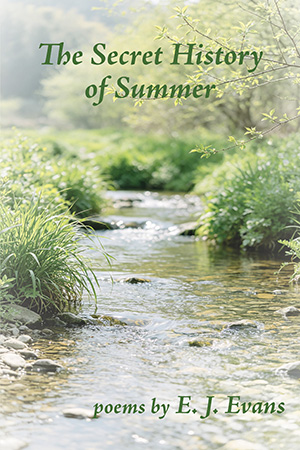
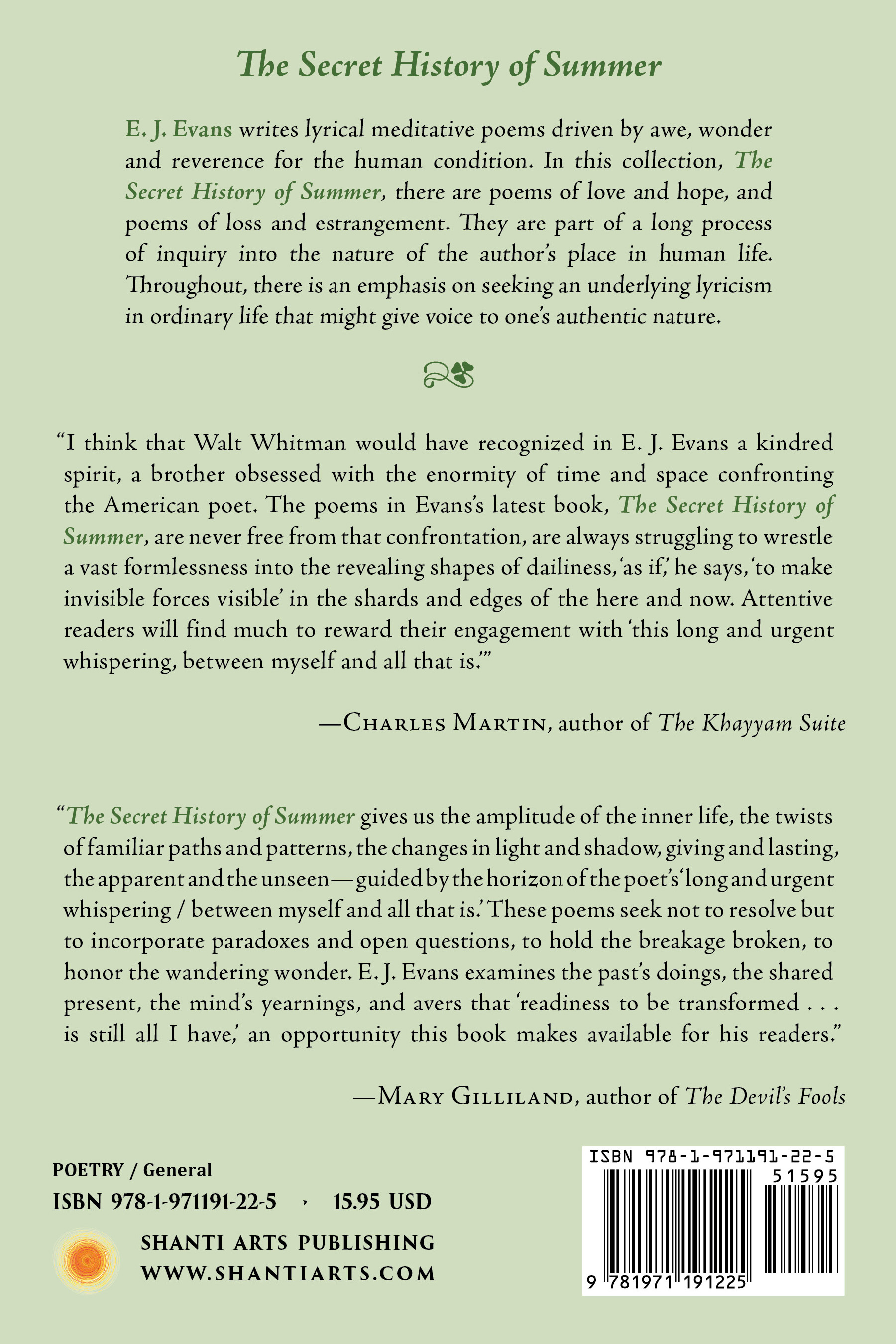
The Secret History of Summer To pay by check please use this order form. We are pleased to take orders from retailers. Email us with details about your order or call us at 207-837-5760. E. J. Evans writes lyrical meditative poems driven by awe, wonder and reverence for the human condition. In this collection, The Secret History of Summer, there are poems of love and hope, and poems of loss and estrangement. They are part of a long process of inquiry into the nature of the author's place in human life. Many of the poems are concerned with trying to understand the changing of the self and its path through the world, especially after having gone through difficult life passages. Throughout, there is an emphasis on seeking an underlying lyricism in ordinary life that might give voice to one's authentic nature. POETRY / General ISBN: 978-1-971191-22-5 (print; softcover; perfect bound) 70 pages |
|
|
|
|
|
“I think that Walt Whitman would have recognized in E. J. Evans a kindred spirit, a brother obsessed with the enormity of time and space confronting the American poet. The poems in Evans’s latest book, The Secret History of Summer, are never free from that confrontation, are always struggling to wrestle a vast formlessness into the revealing shapes of dailiness, ‘as if,’ he says, ‘to make invisible forces visible’ in the shards and edges of the here and now. Attentive readers will find much to reward their engagement with ‘this long and urgent whispering, between myself and all that is.’” “The Secret History of Summer gives us the amplitude of the inner life, the twists of familiar paths and patterns, the changes in light and shadow, giving and lasting, the apparent and the unseen—guided by the horizon of the poet’s ‘long and urgent whispering / between myself and all that is.’ These poems seek not to resolve but to incorporate paradoxes and open questions, to hold the breakage broken, to honor the wandering wonder. E. J. Evans examines the past’s doings, the shared present, the mind’s yearnings, and avers that ‘readiness to be transformed . . . is still all I have,’ an opportunity this book makes available for his readers.” |
|
|