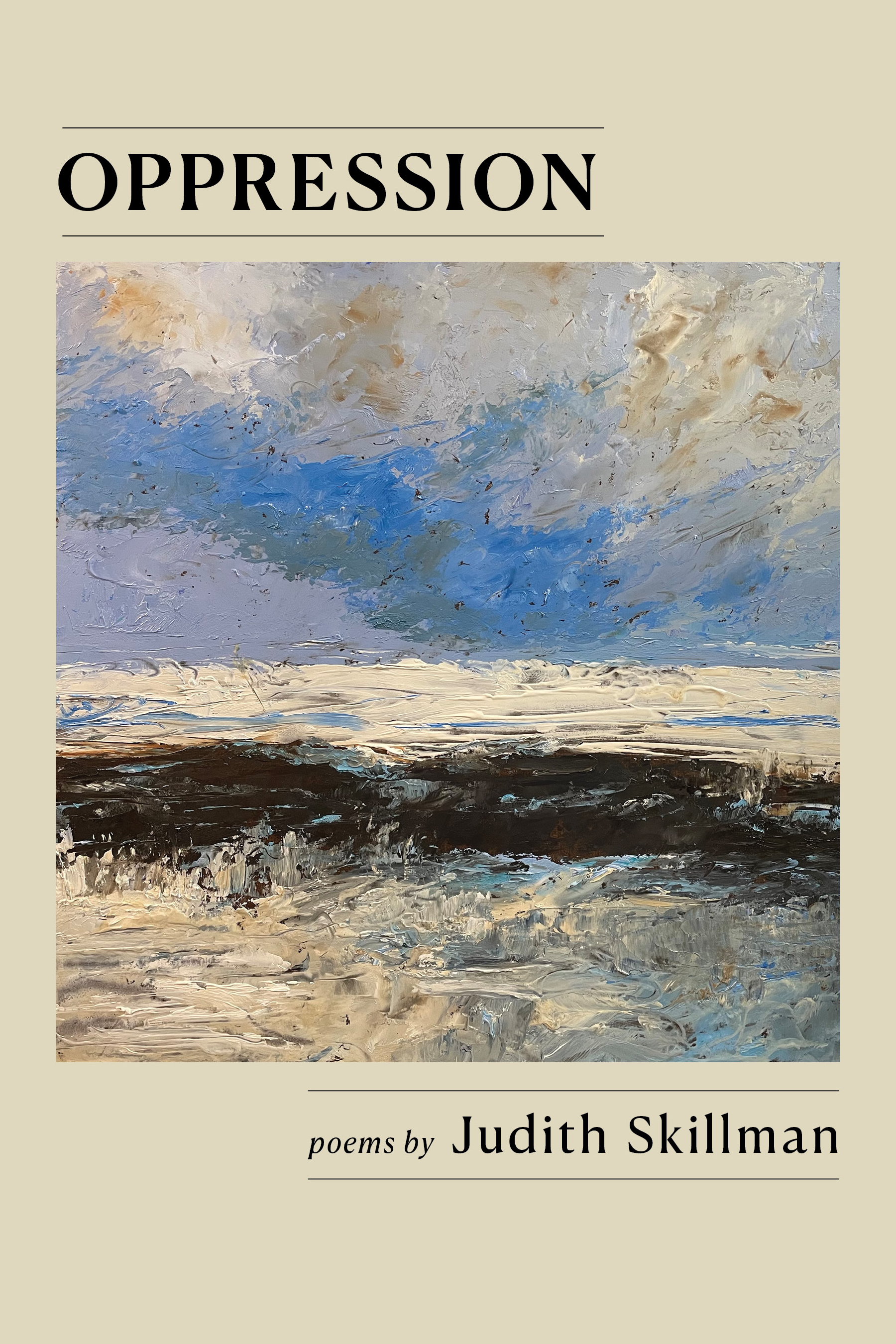
Oppression To pay by check please use this order form. We are pleased to take orders from retailers. Email us with details about your order or call us at 207-837-5760. The central theme of Oppression is war and the innate cruelty of humanity, especially as seen through WWII’s lingering, intergenerational impacts on ancestral figures portrayed in these poems. Patriarchal dominance as it influences domestic life emerges prominently in “You Watch” and “Arguments of the Dead.” Women’s issues begin the collection with “Two of Every” and are further developed through mythological allusions to Penelope, Demeter, and Persephone. Organic imagery—birds, horses, rabbits, chickweed, crabapples—thread Oppression’s five-part structure, and move the reader from domesticity through the immigrant experience, woundedness, and music. While this work is dark, it is hopeful, as if to spite the cynical personas who inhabit the poems. POETRY / General ISBN: 978-1-971191*00-3 (print; softcover; perfect bound) Released April 2026 | Copyright 2026 86 pages |
|
 |
|
|
|
|
|
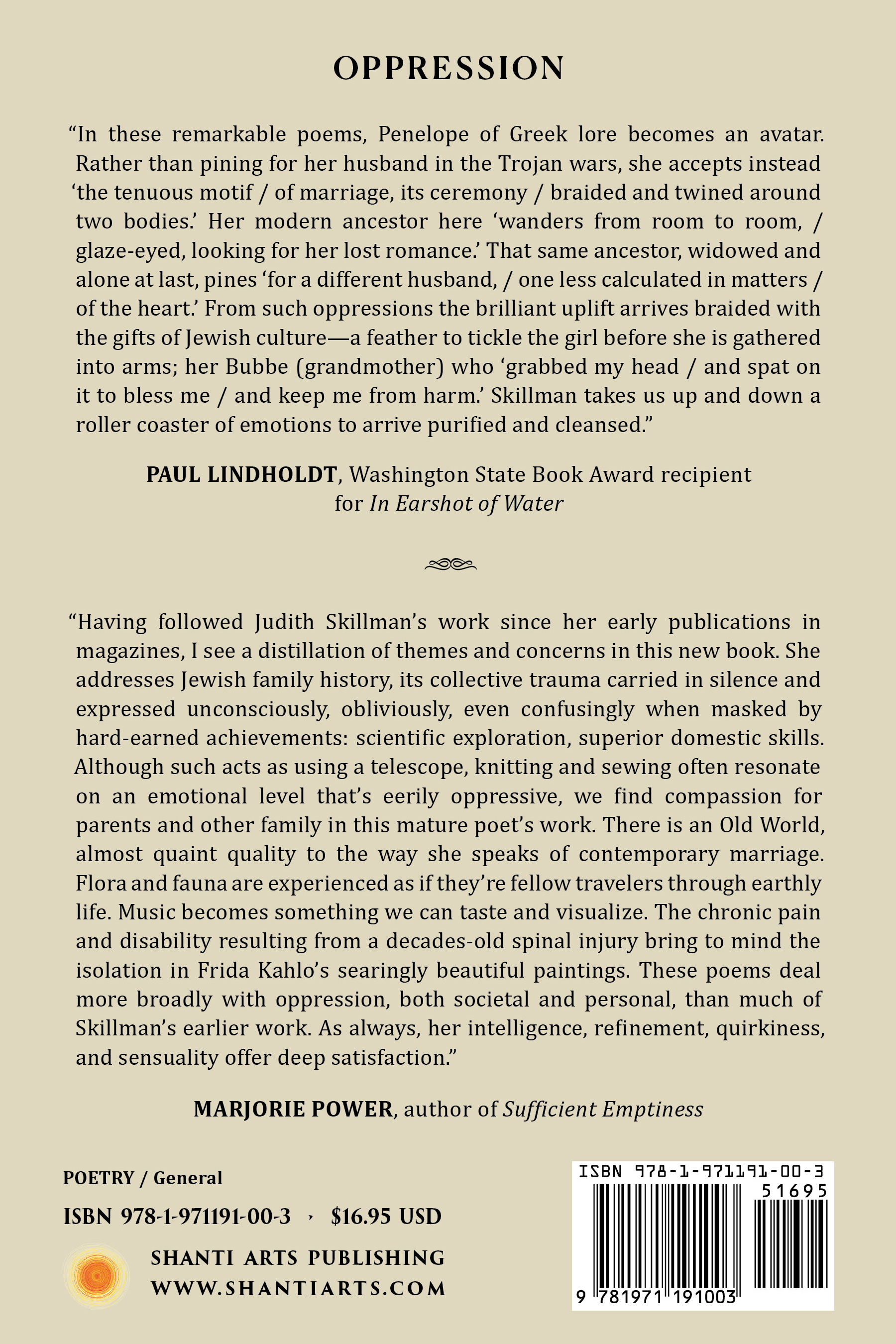
“In these remarkable poems, Penelope of Greek lore becomes an avatar. Rather than pining for her husband in the Trojan wars, she accepts instead “the tenuous motif / of marriage, its ceremony / braided and twined around two bodies.” Her modern ancestor here “wanders from room to room, / glaze-eyed, looking for her lost romance.” That same ancestor, widowed and alone at last, pines “for a different husband, / one less calculated in matters / of the heart.” From such oppressions the brilliant uplift arrives braided with the gifts of Jewish culture—a feather to tickle the girl before she is gathered into arms; her Bubbe (grandmother) who “grabbed my head / and spat on it to bless me / and keep me from harm.” Skillman takes us up and down a roller coaster of emotions to arrive purified and cleansed.” “Having followed Judith Skillman’s work since her early publications in magazines, I see a distillation of themes and concerns in this new book. She addresses Jewish family history, its collective trauma carried in silence and expressed unconsciously, obliviously, even confusingly when masked by hard-earned achievements: scientific exploration, superior domestic skills. Although such acts as using a telescope, knitting and sewing often resonate on an emotional level that’s eerily oppressive, we find compassion for parents and other family in this mature poet’s work. There is an Old World, almost quaint quality to the way she speaks of contemporary marriage. Flora and fauna are experienced as if they’re fellow travelers through earthly life. Music becomes something we can taste and visualize. The chronic pain and disability resulting from a decades-old spinal injury bring to mind the isolation in Frida Kahlo’s searingly beautiful paintings. These poems deal more broadly with oppression, both societal and personal, than much of Skillman’s earlier work. As always, her intelligence, refinement, quirkiness, and sensuality offer deep satisfaction. “Few poets seize the natural world in the tender, particular ways that Judith Skillman does . . . For a poet who sees this world as does Skillman, nature’s beauty and cruelty is ours as well.”. “Skillman’s ability to accommodate multiple meanings in even the most seemingly straightforward of sentences is like being pushed by a doppelganger who insists we jump beyond obvious interpretations.” “Judith Skillman’s twentieth book takes us on a journey through the poet’s personal and family experience of oppression using a wide range of metaphors: myth, music, domesticity. Wry humor is skillfully inserted throughout the volume to balance tone—as in ‘Silver Lining,’ where aunts, ‘waltz(ing) nude beneath housedresses / and smoking jackets.’ Several sewing poems demonstrate deft language usage —one, titled ‘Remnant,’ refers to a ‘scrap of memory,’ where her mother is unable ‘to realize the least / of my problems / was being left-handed.’ Old horrors are revisited, ‘coaxed by a bar of soap, they / went naked to shower . . . ’ Newer issues, ‘Now we’re thinking / how to save what’s left of the world.’ Poems dealing with chronic pain are illuminating for those who have been lucky to avoid it. The poet likens it to beak drills, ‘by a woodpecker.’ In the final poem Skillman reflects on the past, ‘winter’s frozen grounds and arguments,’ concluding, ‘I vow once more to let whatever lies beneath a soul trill / summer, summer, summer.’ Read this book! You’ll be enlightened.” |
|
|
|
News and Reviews Mary Ellen Talley, Review, Mom Egg Review (9-16-2026) Kurt Olsson, Review, Compulsive Reader (8-26-2026) |
|
|
|
|