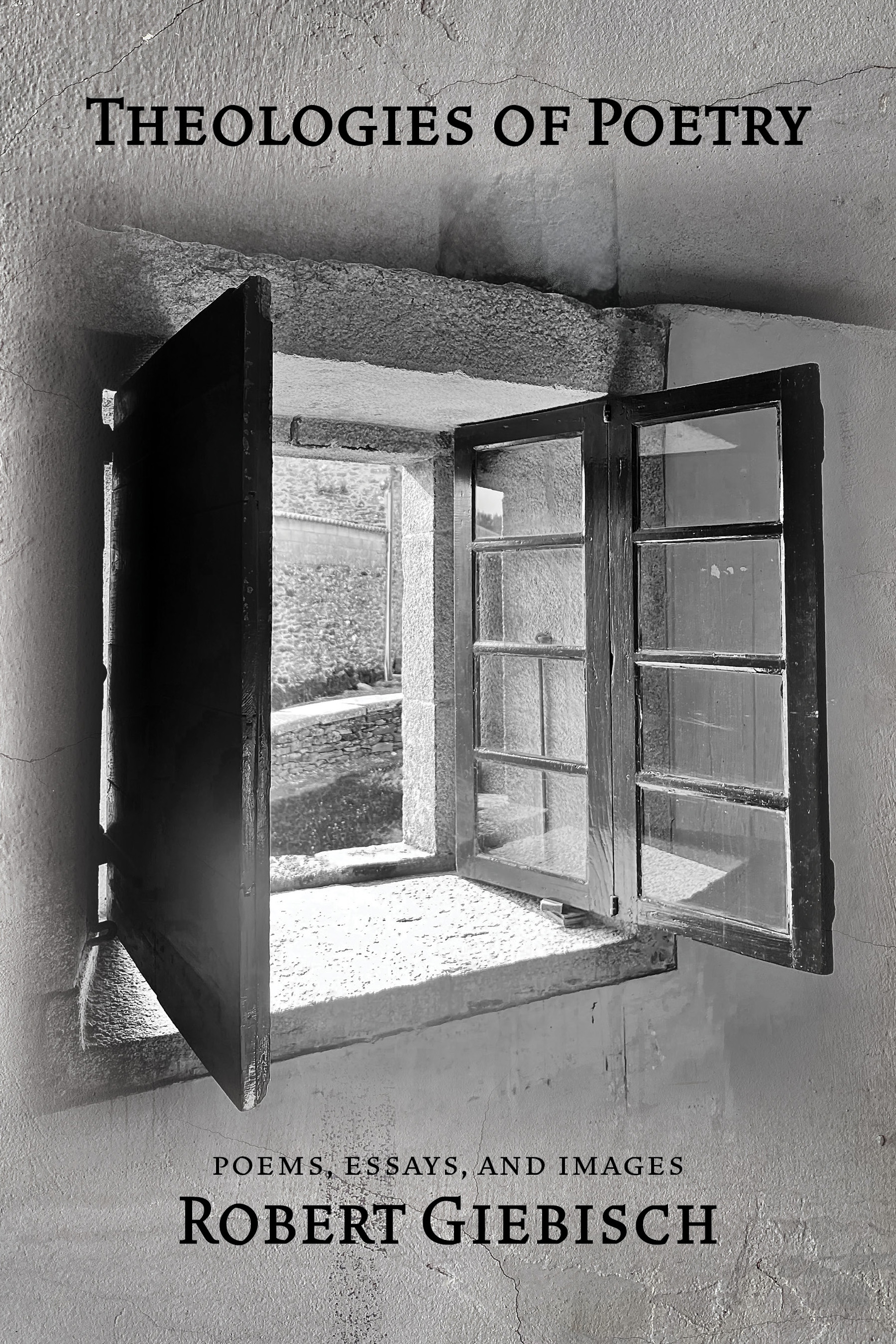
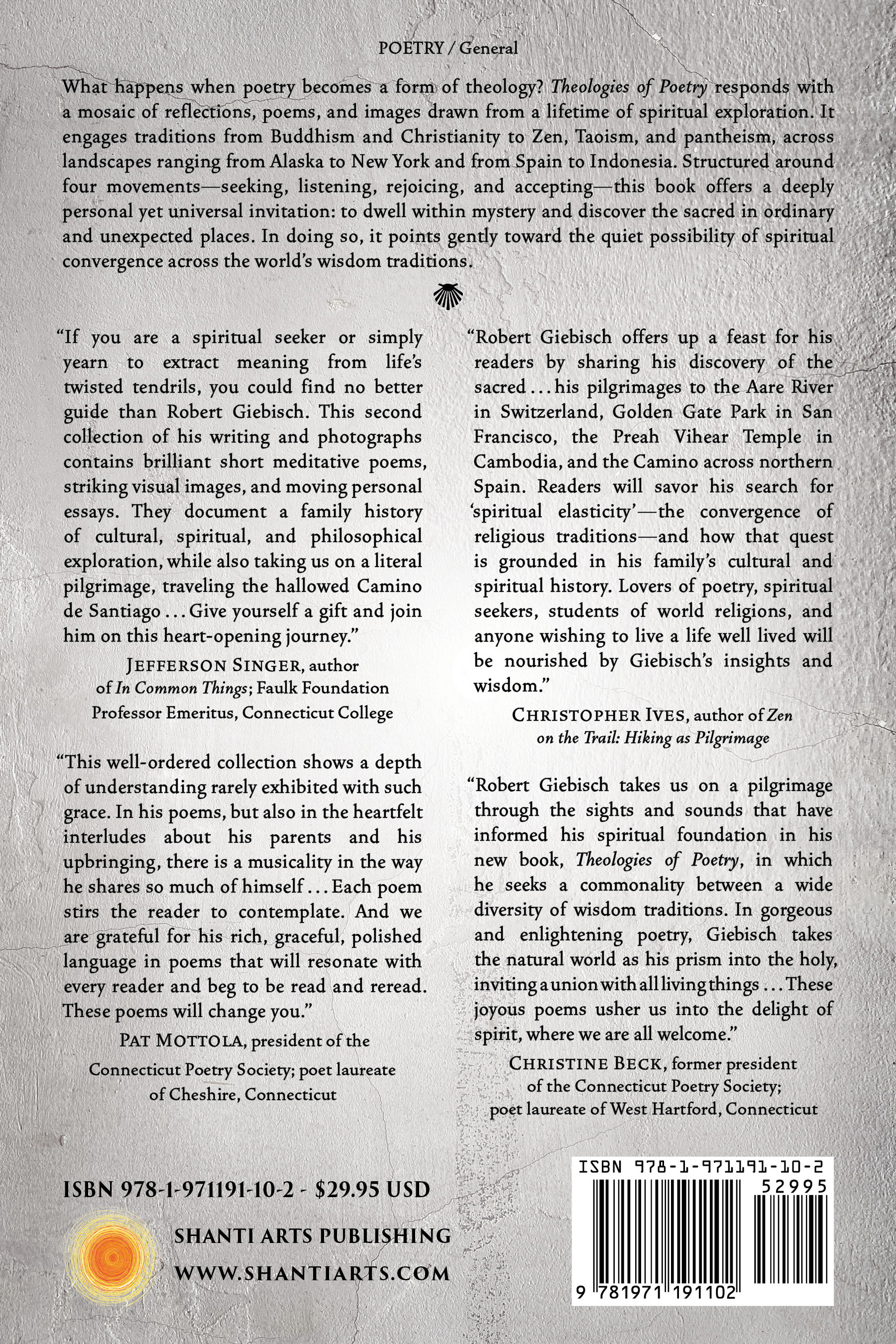
Theologies of Poetry Print (hardcover with dust jacket; "Collector's Edition"): $52.00 To pay by check please use this order form. We are pleased to take orders from retailers. Email us with details about your order or call us at 207-837-5760. What happens when poetry becomes a form of theology? Theologies of Poetry responds with a mosaic of reflections, poems, and images drawn from a lifetime of spiritual exploration. It engages traditions from Buddhism and Christianity to Zen, Taoism, and pantheism, across landscapes ranging from Alaska to New York and from Spain to Indonesia. Structured around four movements—seeking, listening, rejoicing, and accepting—this book offers a deeply personal yet universal invitation: to dwell within mystery and discover the sacred in ordinary and unexpected places. In doing so, it points gently toward the quiet possibility of spiritual convergence across the world’s wisdom traditions. POETRY / General ISBN: 978-1-971191-10-2 (softcover; perfect bound; 29 black-and-white photographs) LCCN: 2026937309 Copyright 2026; released March 17, 2026 204 pages |
|
 |
|
|
|
|
|
|
|
“If you are a spiritual seeker or simply yearn to extract meaning from life’s twisted tendrils, you could find no better guide than Robert Giebisch. This second collection of his writing and photographs contains brilliant short meditative poems, striking visual images, and moving personal essays. They document a family history of cultural, spiritual, and philosophical exploration, while also taking us on a literal pilgrimage, traveling the hallowed Camino de Santiago. Giebisch witnesses ‘the drift between heart beats, where quiet gathers / where a gaze meets mine / and breathes through me.’ Give yourself a gift and join him on this heart-opening journey.” “Robert Giebisch's Theologies of Poetry is an intricately woven tapestry of poetry and prose, each enriching the other. This well-ordered collection shows a depth of understanding rarely exhibited with such grace. In his poems, but also in the heartfelt interludes about his parents and his upbringing, there is a musicality in the way he shares so much of himself. Through his generosity, the reader shares the quiet room of the poet. Each poem stirs the reader to contemplate. And we are grateful for his rich, graceful, polished language in poems that will resonate with every reader and beg to be read and reread. These poems will change you.” “Robert Giebisch offers up a feast for his readers by sharing his discovery of the sacred in falling acorns, trembling ferns, and hovering dragonflies. Poetic images of breathing together with streams, branches, and pine needles illuminate the spirit that animates his pilgrimages to the Aare River in Switzerland, Golden Gate Park in San Francisco, the Preah Vihear Temple in Cambodia, and the Camino across northern Spain. Readers will savor his search for ‘spiritual elasticity’—the convergence of religious traditions—and how that quest is grounded in his family’s cultural and spiritual history. Lovers of poetry, spiritual seekers, students of world religions, and anyone wishing to live a life well lived will be nourished by Giebisch’s insights and wisdom.” “Robert Giebisch takes us on a pilgrimage through the sights and sounds that have informed his spiritual foundation in his new book, Theologies of Poetry, in which he seeks a commonality between a wide diversity of wisdom traditions. In gorgeous and enlightening poetry, Giebisch takes the natural world as his prism into the holy, inviting a union with all living things. In ‘Church of Fog,’ for example, he sees a heron lifting on a river, ‘like a breath you forget is yours,’ adding ‘nothing here is waiting.’ These joyous poems usher us into the delight of spirit, where we are all welcome.” “Giebisch speaks with God through spare, vivid poems, Catholicism, Buddhism, and mindful meditation. His Theos logos—birds, trees, dreams, breath, music—are grounded in nature, as John Muir wrote, ‘rocks and water . . . . are words of God . . . . ’; He finds his soul restored in walking, appreciation for loved ones and good health in aging, ‘our steps once long, now careful.’ Through the stillness in walking, he apprehends God as “a silence that listens.” Stillness is in fact, the last word in this lovely book, where I have heard with great pleasure, ‘a murmur of dream and feeling, / drinking green silence/to fullness.’” |
|
|
|
News and Reviews |
|
|
|
|